MBBR vs SBR vs MBR: Choosing the Right STP Technology
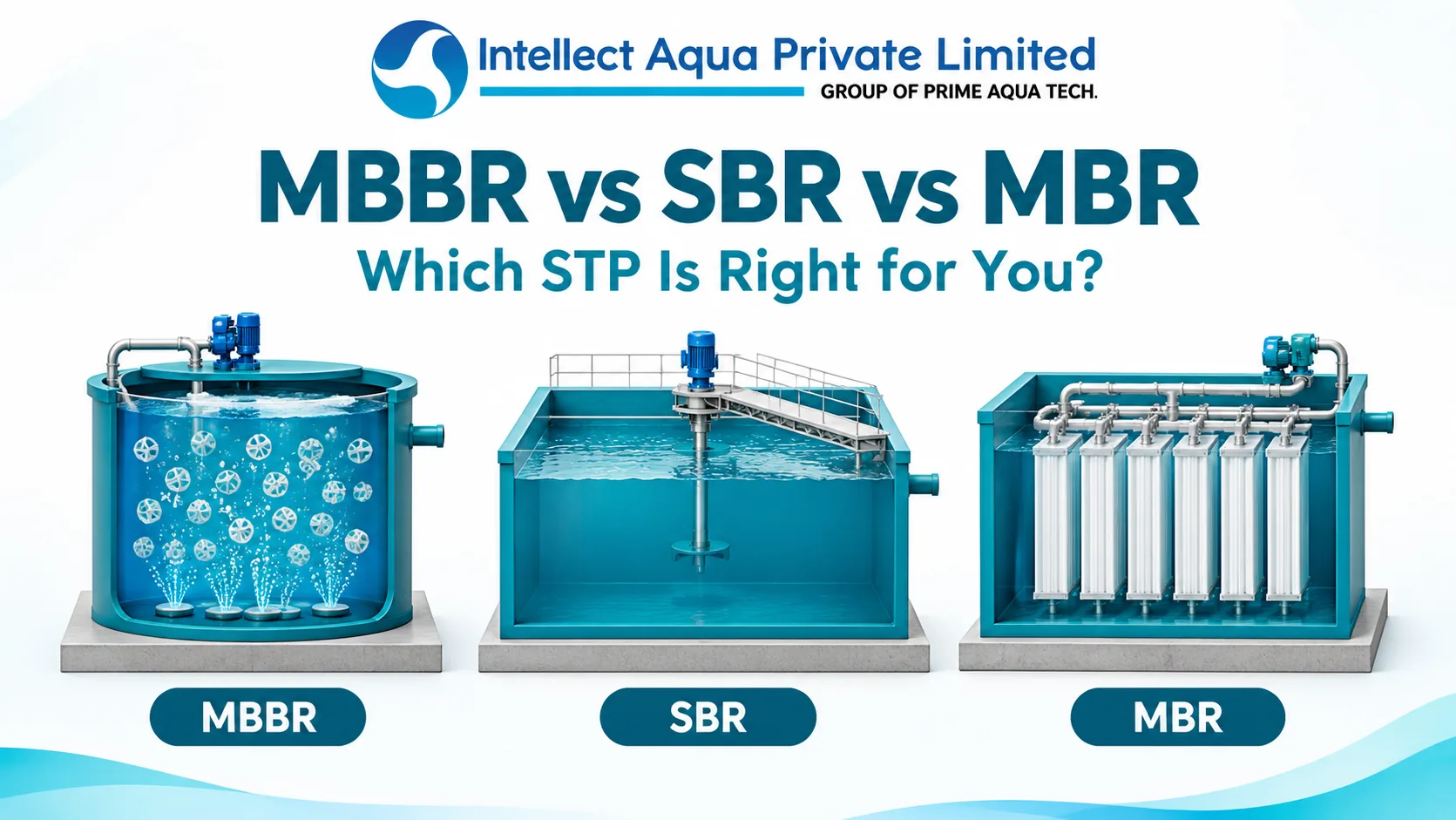
Choosing a sewage treatment plant is a 15 to 20 year decision. The technology you pick decides how much land the plant takes, how clean the treated water is, what your monthly power bill looks like and how much attention the operator has to give it every day. Most new plants in India today use one of three technologies: MBBR (Moving Bed Biofilm Reactor), SBR (Sequencing Batch Reactor) or MBR (Membrane Bioreactor).
All three are proven. None of them is the best for every site. This guide compares them side by side and shows which one fits apartments, hospitals, hotels, factories and campuses, so you can go into a vendor meeting knowing what to ask for.
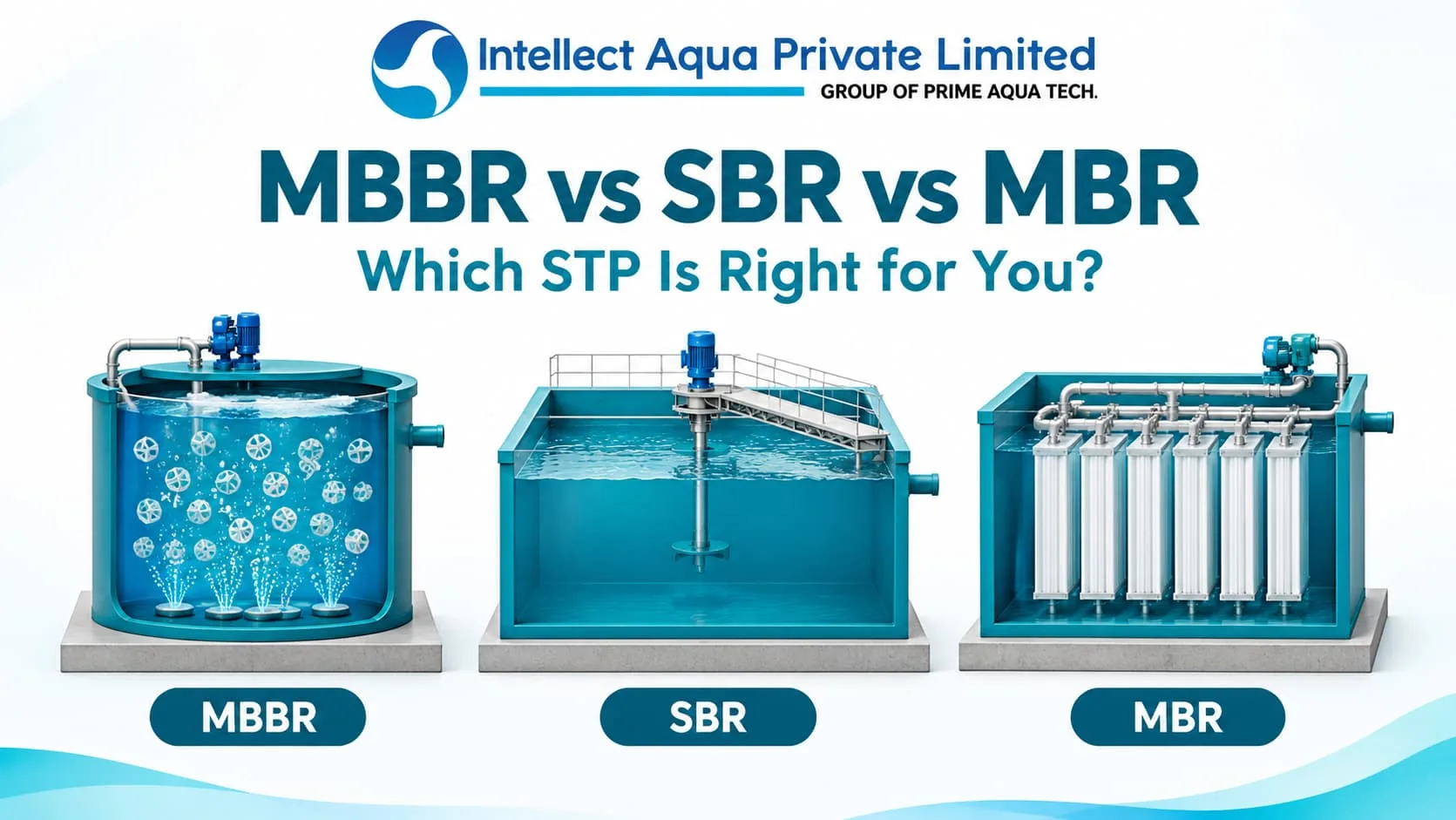
How Each Technology Works in One Paragraph
MBBR: bacteria living on floating media
An MBBR STP fills the aeration tank, usually 40 to 60 percent, with small plastic carriers that have a very large surface area. Bacteria grow as a thin biofilm on these carriers. Air from fine bubble diffusers keeps the media moving and supplies oxygen, so the biofilm keeps eating the organic load. Because the bacteria stay attached to the media, the plant holds more biomass in a smaller tank, needs no sludge recirculation from the clarifier, and bounces back quickly after a shock load. Treated water goes to a settling tank, then usually a pressure sand filter and activated carbon filter before disinfection.
SBR: everything in one tank, in timed steps
An SBR STP does aeration and settling in the same tank, one batch at a time. Each cycle has five steps: fill, react (aerate), settle, decant and idle. A PLC controls the timing, blowers and decanter. Since settling happens in the reactor, there is no separate secondary clarifier. Changing the cycle times lets the operator tune the plant for nitrogen and phosphorus removal, which is the big strength of SBR. Most SBR plants use two or more tanks so one can fill while another treats.
MBR: activated sludge plus a membrane filter
An MBR STP combines a normal aeration tank with ultrafiltration or microfiltration membranes. The membranes have pores far smaller than bacteria, so they physically hold back almost all suspended solids and most pathogens. Clean water (permeate) is pulled through the membranes by suction pumps, which replaces the clarifier and the sand filter. The plant can run at a much higher biomass concentration, which shrinks the tank size and gives the clearest treated water of the three.
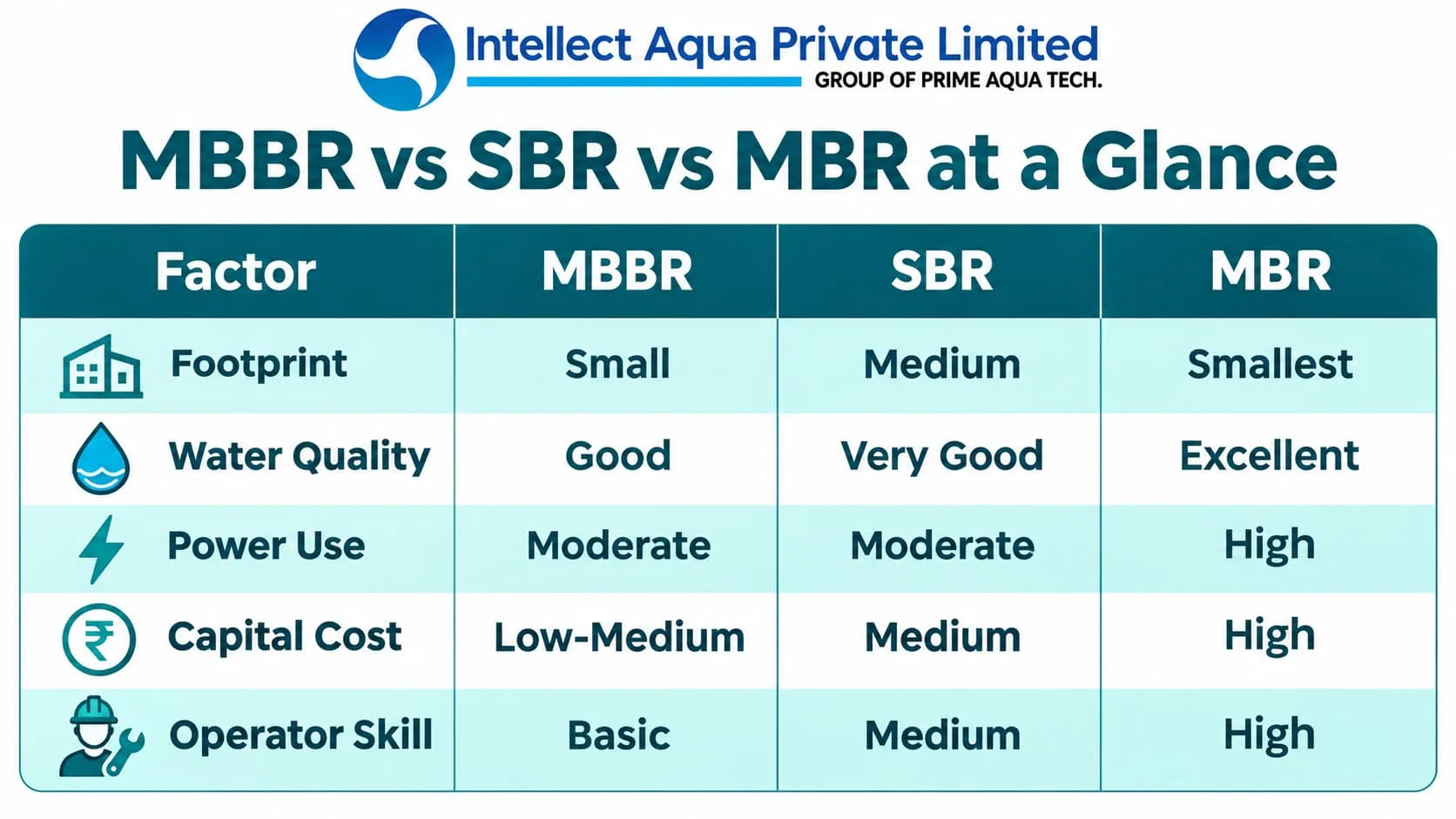
Comparison Table: Footprint, Output Quality, Power, Cost, Skill
Here is how the three technologies compare on the factors that matter most to a building owner or plant manager. These are typical ranges; actual values depend on capacity, sewage strength and design.
| Factor | MBBR | SBR | MBR |
|---|---|---|---|
| Footprint | Small | Medium | Smallest |
| Treated water quality | Good; meets discharge norms with a tertiary filter | Good to very good; strong nutrient removal | Excellent; near-zero suspended solids, reuse-ready |
| Power use | Moderate | Moderate (aeration only in react phase) | High (membrane scouring + suction pumps) |
| Capital cost | Low to medium | Medium | High |
| Running cost | Low to medium | Medium | High (power, chemicals, membrane replacement) |
| Operator skill | Basic | Medium; depends on PLC and sensors | High; membrane cleaning and monitoring |
| Handles load swings | Good | Very good | Good |
| Best known for | Simple, robust, compact | Flexible batch control | Highest quality in least space |
The short version: MBBR is the balanced, low-maintenance choice. SBR gives the most control over varying loads and nutrients. MBR gives the best water in the smallest space, but at the highest cost.
One point many buyers miss: the cheapest plant to build is not always the cheapest to own. Over 15 years, power and maintenance can cost more than the plant itself. Always compare running cost per KLD, not just the quotation.
Best Fit: Apartments, Hospitals, Hotels, Factories, Campuses
Flow pattern, available space, reuse needs and the skill of the people running the plant decide the right technology more than anything else. Here is how that usually plays out:
| Site type | Usual best fit | Why |
|---|---|---|
| Apartments and gated communities | MBBR | Steady flow, limited space, and association staff who need a plant that runs without constant tuning. |
| Hospitals | MBBR or MBR | Continuous flow and strict hygiene. MBR when water is reused for flushing or cooling, or when space is very tight. |
| Hotels and resorts | SBR or MBR | Big swings between peak and quiet hours suit SBR batches. MBR when landscaping reuse and odour-free, clear water matter. |
| Factories (domestic sewage) | MBBR | Handles shift-based load changes well and pairs easily with an existing ETP or reuse line. |
| Colleges and campuses | SBR or MBBR | Load drops sharply during holidays. SBR adapts its cycles; MBBR biofilm recovers quickly after low-load periods. |
These are starting points, not rules. A large apartment complex that wants to send treated water to an RO plant for higher reuse may be better off with MBR. A small hotel with a part-time operator may prefer MBBR over SBR. If you are planning an STP in Chennai, where land costs are high and water reuse rules for large buildings are tight, footprint and reuse quality will weigh more heavily in the choice.
When to Choose MBR Despite Higher Cost
MBR costs more to build and run, so it should be chosen for a clear reason. It is worth the extra spend when:
- Space is very limited. Basement plants in commercial buildings and hospitals often have no room for clarifiers and filters.
- You plan high-grade reuse. Flushing, cooling tower make-up and RO feed all benefit from water with almost no suspended solids. MBR permeate lowers fouling in downstream RO membranes.
- Discharge norms are strict. Where your consent conditions demand very low BOD and TSS consistently, MBR gives the most margin.
- You are expanding without new land. An existing aeration tank can often be converted to MBR to treat more sewage in the same footprint.
- Trained operators or an O&M contract are in place. Membranes need regular cleaning, integrity checks and careful handling. Without this, performance drops fast.
If none of these apply, a well-designed MBBR or SBR with a good tertiary filter will meet the norms at a lower lifetime cost.
Upgrading an Old ASP Plant to MBBR
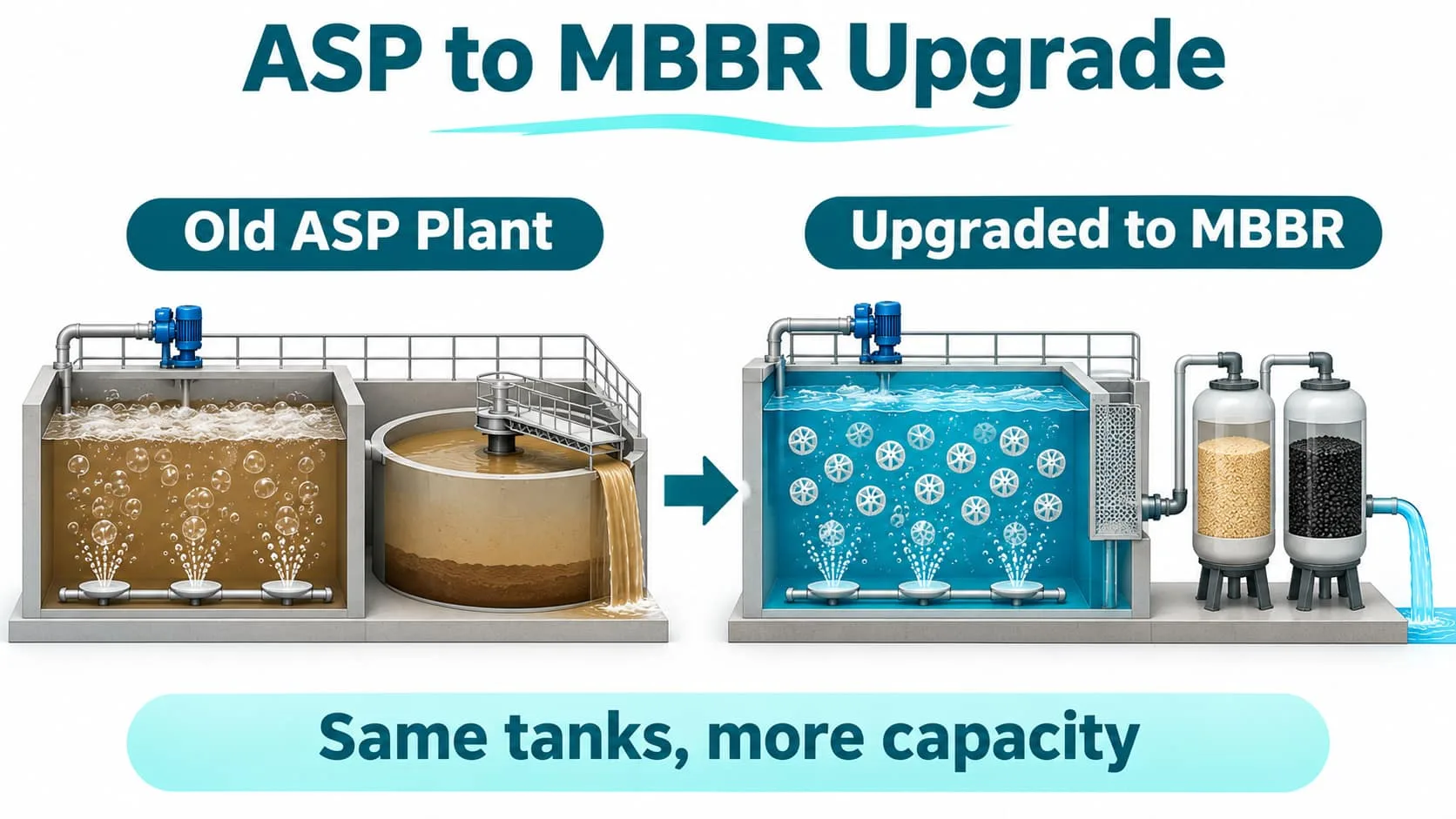
Many older buildings run a conventional Activated Sludge Process (ASP) plant. These plants often struggle when occupancy grows, when the norms get stricter, or when sludge bulking makes the clarifier overflow. Rebuilding from scratch is rarely needed. In most cases the plant can be retrofitted to MBBR using the same tanks.
A typical ASP to MBBR upgrade involves:
- Site audit: checking inlet flow, sewage strength, tank sizes, blower capacity and the condition of the clarifier.
- Adding media: filling the existing aeration tank with MBBR carriers to multiply the active biomass.
- Retaining screens: installing screens at the tank outlet so the media stays inside.
- Better aeration: replacing old diffusers with fine or medium bubble diffusers and upgrading the blower if needed.
- Tertiary polishing: adding or repairing the sand and carbon filters and disinfection.
The result is usually higher treatment capacity in the same tanks, less sludge recirculation trouble and steadier output quality, often with the plant running during most of the work. It is one of the most cost-effective ways to bring an old STP up to current norms.
FAQs
Which is better, MBBR or SBR?
Neither is better everywhere. MBBR suits sites with steady, continuous sewage flow and operators with basic skills, because it runs without complex timers. SBR suits sites with strong peak-and-lull flows, such as hotels and campuses, and where nitrogen and phosphorus removal matters, but it needs a reliable PLC and trained staff.
Is MBR treated water safe for reuse?
MBR permeate is very clear, with suspended solids close to nil, which makes it well suited for flushing, cooling towers, landscaping and as feed to an RO plant. For any reuse, the water should still be disinfected and tested against the standards set in your pollution control board consent.
Which STP needs the least space?
MBR needs the least space because it removes the secondary clarifier and runs at high biomass concentration. MBBR comes next and is usually the best balance of compact size and cost. SBR saves space by using one tank for treatment and settling, but its tanks are larger than MBBR for the same flow.
Can an existing ASP plant be converted to MBBR?
Yes. In most cases the existing aeration tank is reused: media carriers, retaining screens and fine bubble diffusers are added, so the plant can handle higher load or meet tighter norms without new civil construction. A site survey is needed first to check tank depth, blower capacity and clarifier condition.
What is the running cost difference between MBBR, SBR and MBR?
MBBR and SBR usually have similar, moderate power use. MBR uses the most power because of membrane air scouring and permeate pumping, and it adds membrane cleaning chemicals and periodic membrane replacement. Exact numbers depend on capacity, load and power tariff, so ask for a per-KLD running cost estimate for your site.
Need Help Choosing?
The right STP depends on your flow, space, reuse plans and who will run it. Share your daily water use and site details with Intellect Aqua, and our team will recommend the technology that fits, with a clear estimate of both build and running cost. Explore our MBBR STP, SBR STP and MBR STP solutions to learn more.