Water Softener vs RO Plant: Which One Does Your Building Need?
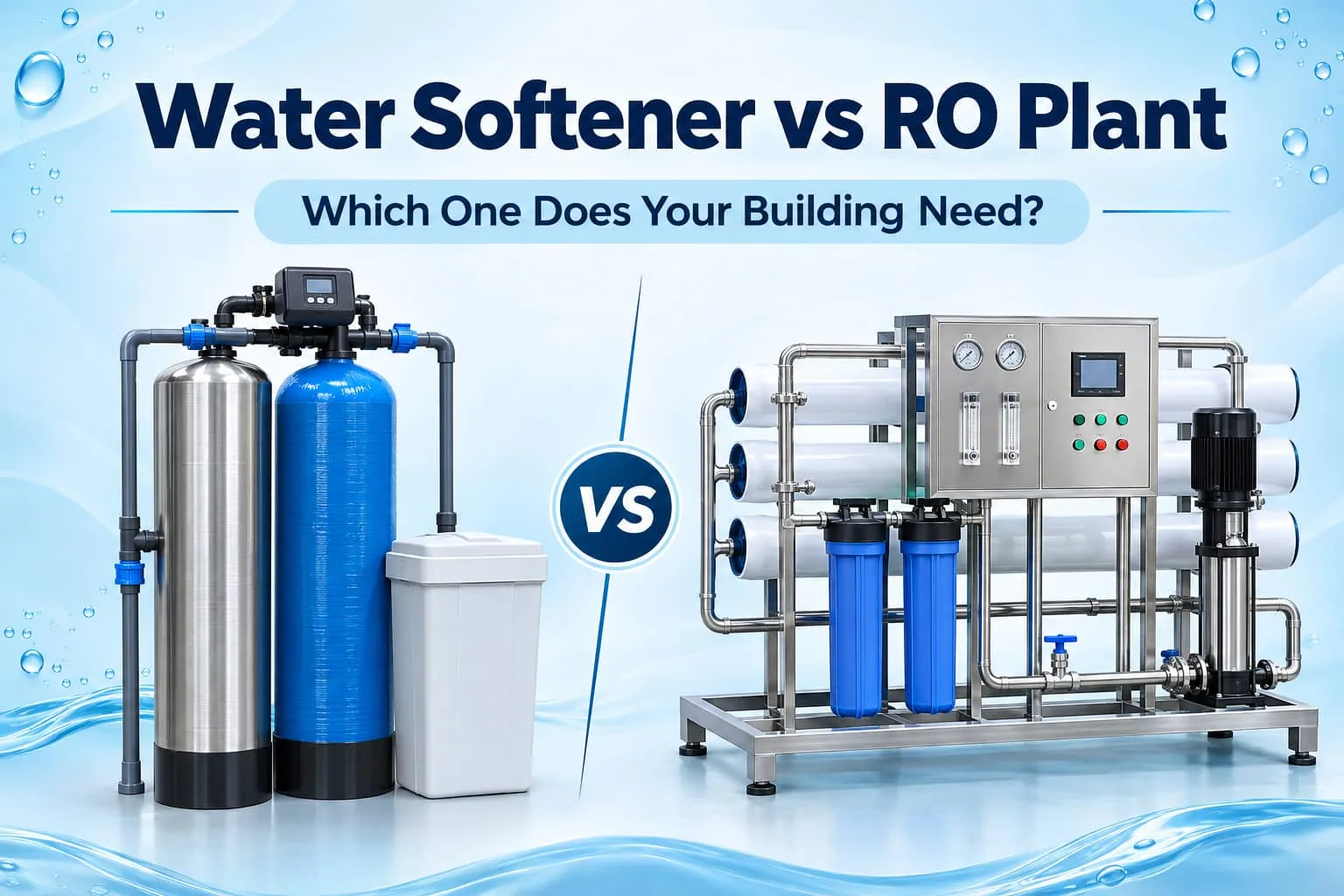
If your taps are crusted with white deposits, your geyser element keeps failing, or the borewell water tastes salty, someone has probably told you to “just put an RO.” Someone else has told you that “a softener is enough.” Both can be right, because the two machines fix different problems.
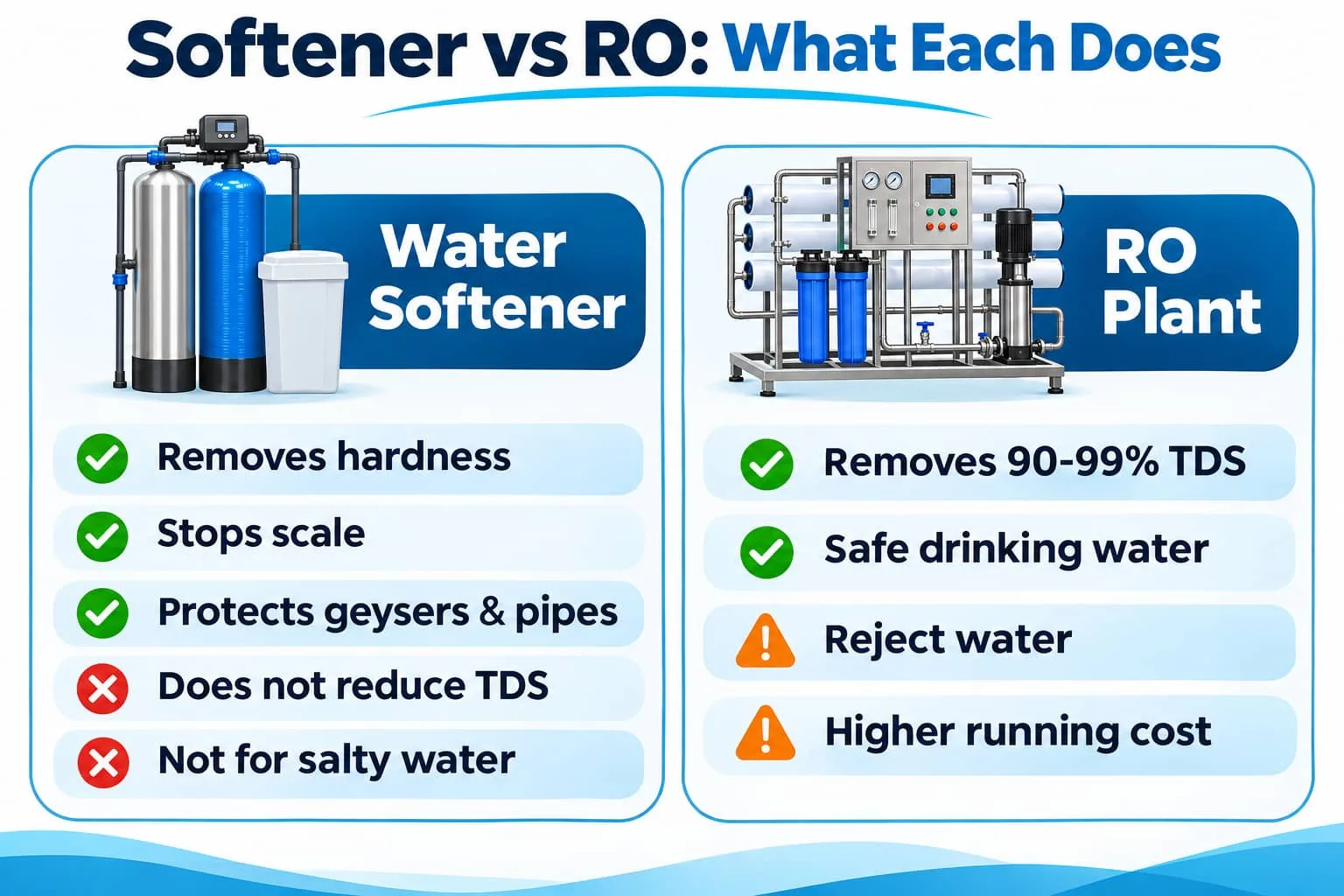
A water softener removes hardness: the calcium and magnesium that cause scale. An RO (reverse osmosis) plant removes almost all dissolved salts, hardness included, along with most other contaminants. Pick the wrong one and you either pay for treatment you don’t need or keep living with the problem you were trying to fix.
This guide explains the difference in plain words, shows you how to decide from a water test report, and explains why most apartments and hotels in Coimbatore and Chennai end up using both.
Short answer: Choose a softener if your water is hard but the TDS is within limits and you mainly want to protect pipes, bathrooms and appliances. Choose RO if the TDS is high, or for water you drink and cook with. If your water is both hard and high in TDS, which is common with borewells in Tamil Nadu, use a softener for the whole building and RO for drinking water.
Hardness vs TDS in plain words
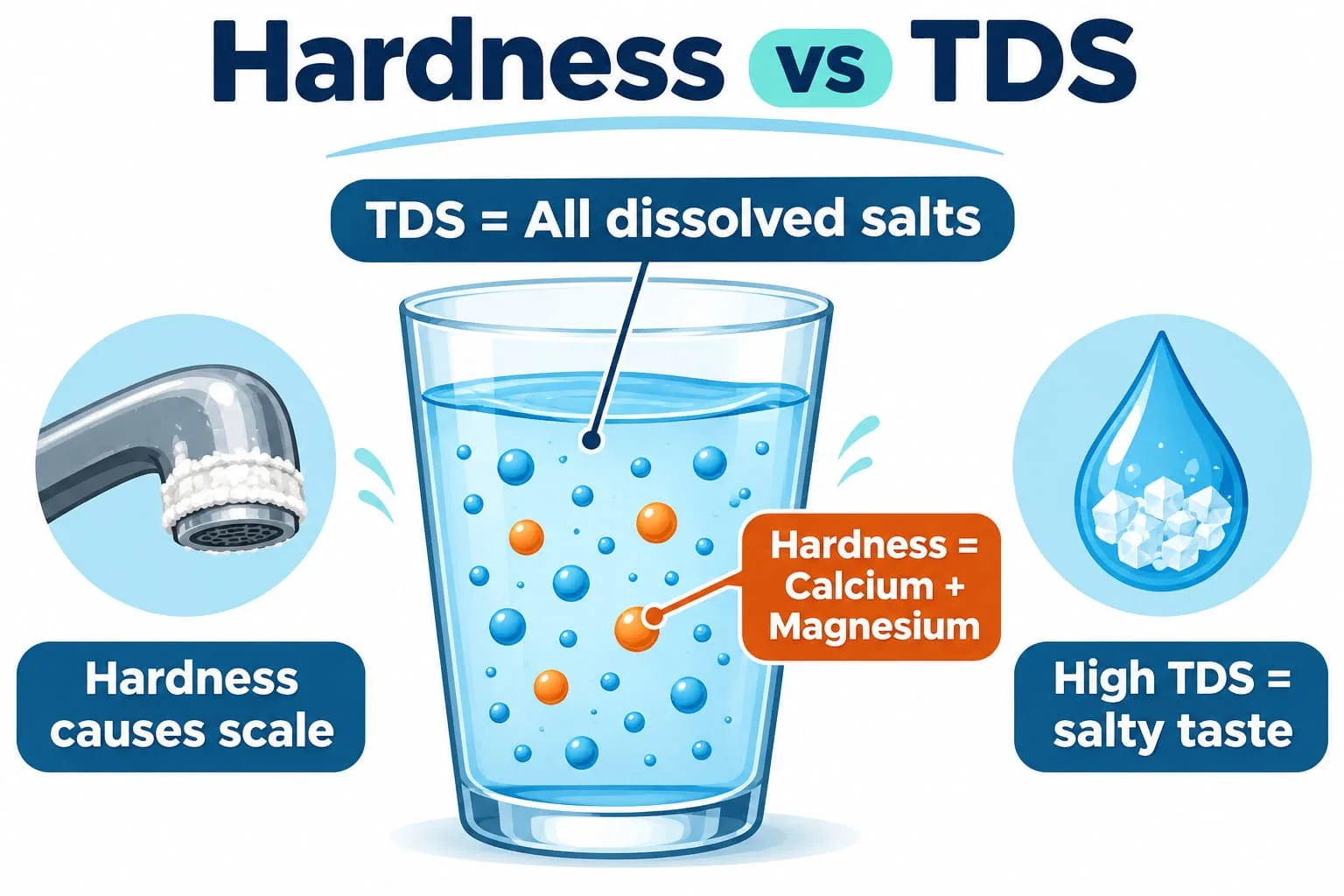
TDS (total dissolved solids) is everything dissolved in your water: calcium, magnesium, sodium, chloride, sulphate, bicarbonate, nitrate, fluoride and more. It is measured in mg/L (the same as ppm). A low-cost TDS pen gives you a reading in seconds.
Hardness is only the calcium and magnesium part of that mix, usually reported as mg/L “as CaCO3”. Hardness is what leaves scale on tiles, taps and heating elements and stops soap from lathering.
So hardness is one slice of TDS. That is why two borewells with the same TDS can behave very differently:
- High TDS, moderate hardness: water that tastes salty or brackish (mostly sodium chloride) but scales less. Common near the coast.
- Moderate TDS, high hardness: water that tastes fine but leaves heavy white scale everywhere.
- High TDS and high hardness: salty and scaling. This is the most common case we see in borewell reports.
The Bureau of Indian Standards drinking water specification (IS 10500) sets these limits:
| Parameter | Acceptable limit | Permissible limit (no alternate source) |
| TDS | 500 mg/L | 2,000 mg/L |
| Total hardness (as CaCO3) | 200 mg/L | 600 mg/L |
One practical warning: a TDS meter cannot tell you hardness. To choose between a softener and RO, you need a proper water test that reports both numbers separately.
What a softener does and does not do
A water softener is a tank of ion-exchange resin. As hard water passes through, the resin captures calcium and magnesium and releases sodium in their place. When the resin is full, the softener regenerates by rinsing itself with brine made from common salt, then goes back into service. Automatic softeners do this on a timer or by metered volume.
What a softener does:
- Brings hardness close to zero
- Stops scale on taps, shower heads, tiles, glass partitions and sanitaryware
- Protects geysers, washing machines, boilers, dishwashers and pipelines
- Makes soap and shampoo lather properly and reduces detergent use
- Protects downstream RO membranes from scaling
What a softener does not do:
- It does not reduce TDS. It swaps one dissolved mineral for another, so TDS stays roughly the same
- It does not make salty or brackish water drinkable
- It does not remove fluoride, nitrate, arsenic or bacteria
- It handles only small amounts of iron; high-iron water needs an iron removal filter first
Softeners are cheap to run. They use salt, very little power and only a small amount of water during regeneration. That makes them the sensible choice for treating every litre that goes to bathrooms, kitchens and laundry. See how our water softener plant systems are sized for apartments, hotels and commercial buildings.
What RO does and its trade-offs
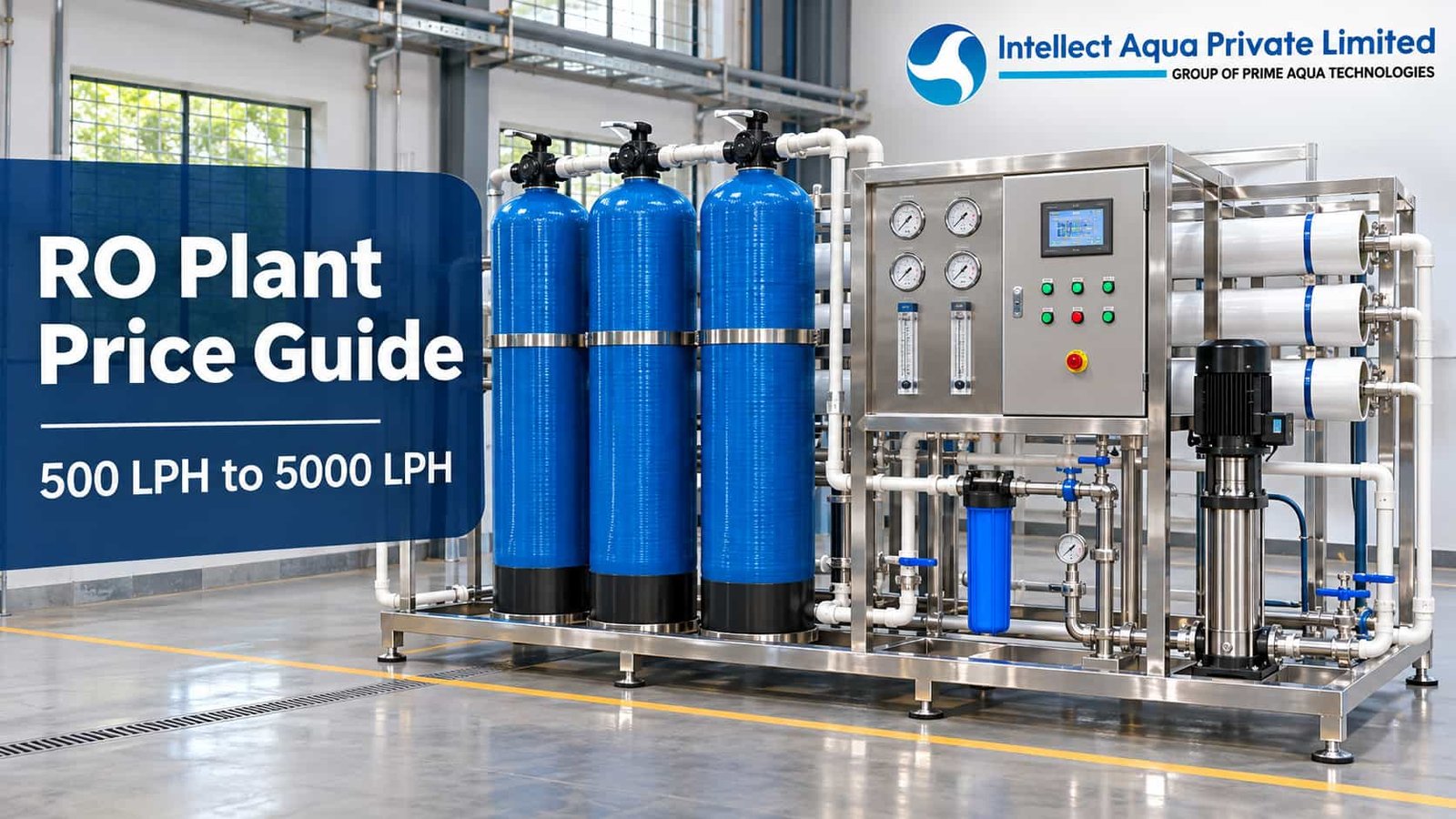
An RO plant uses a high-pressure pump to push water through a semi-permeable membrane. Water passes through; most dissolved salts do not. A well-designed RO plant typically removes 90 to 99 percent of dissolved solids, including hardness, chloride, fluoride, nitrate and most heavy metals. Commercial RO plants also include pre-treatment, usually a sand filter, an activated carbon filter, a micron cartridge filter and antiscalant dosing.
RO produces water that is fit for drinking and cooking even from poor sources, but it comes with trade-offs:
- Reject water: RO always sends part of the feed water to drain as concentrated reject. Commercial plants commonly recover 50 to 75 percent of the feed; the rest is reject. That reject has to be managed, for example by reusing it for floor washing or flushing where its TDS allows.
- Power: the high-pressure pump runs every time the plant produces water.
- Membrane care: hard feed water scales membranes quickly. RO plants need antiscalant or softened feed water, periodic chemical cleaning and membrane replacement every few years.
- Very low TDS output: heavily purified water can taste flat. Good systems use a blending valve or a mineral cartridge to bring taste back.
- Cost: capital and running costs are higher than a softener, so purifying every litre used for bathing and flushing is usually wasteful.
If you need drinking water you can trust from a borewell or tanker source, read more about our RO plant in Coimbatore.
Decision table by water test result
Use the TDS and total hardness values from your water test report to find your situation:
| Your water test result | What it means | What you need |
| TDS under 500, hardness under 200 | Good quality for most uses | Basic filtration, plus UV or a small RO for drinking if you prefer |
| TDS under 500, hardness above 200 | Scaling problem, salts are fine | Softener for the whole building; RO optional for drinking |
| TDS 500 to 2,000, hardness under 200 | Salty, but low scaling | RO for drinking and cooking; a softener will not help |
| TDS 500 to 2,000, hardness above 200 | Salty and scaling | Softener for the whole building plus RO for drinking |
| TDS above 2,000 | Beyond the permissible drinking limit | RO is essential, designed for brackish water, with strong pre-treatment |
| Iron, turbidity, colour or smell present | Other contaminants on top of the above | Sand, carbon or iron removal filters before the softener or RO |
A few tips for an accurate decision:
- Ask the lab for TDS, total hardness, pH, iron, chloride, fluoride, nitrate and a bacteria test, not just TDS.
- Collect the sample from the source (borewell outlet or sump), not from an existing filter.
- Borewell quality changes with the season, so retest at least once a year and again after the monsoon.
Why most apartments need both
Think about how a building actually uses water. Drinking and cooking take only a few litres per person per day. Bathing, flushing, washing clothes and cleaning take many times that. Different uses need different treatment.
Running RO on all that water means paying to purify water that goes down the toilet, sending a large share of your borewell supply to drain as reject, and wearing out membranes faster.
Running only a softener protects the plumbing, but leaves residents drinking water that is still high in TDS.
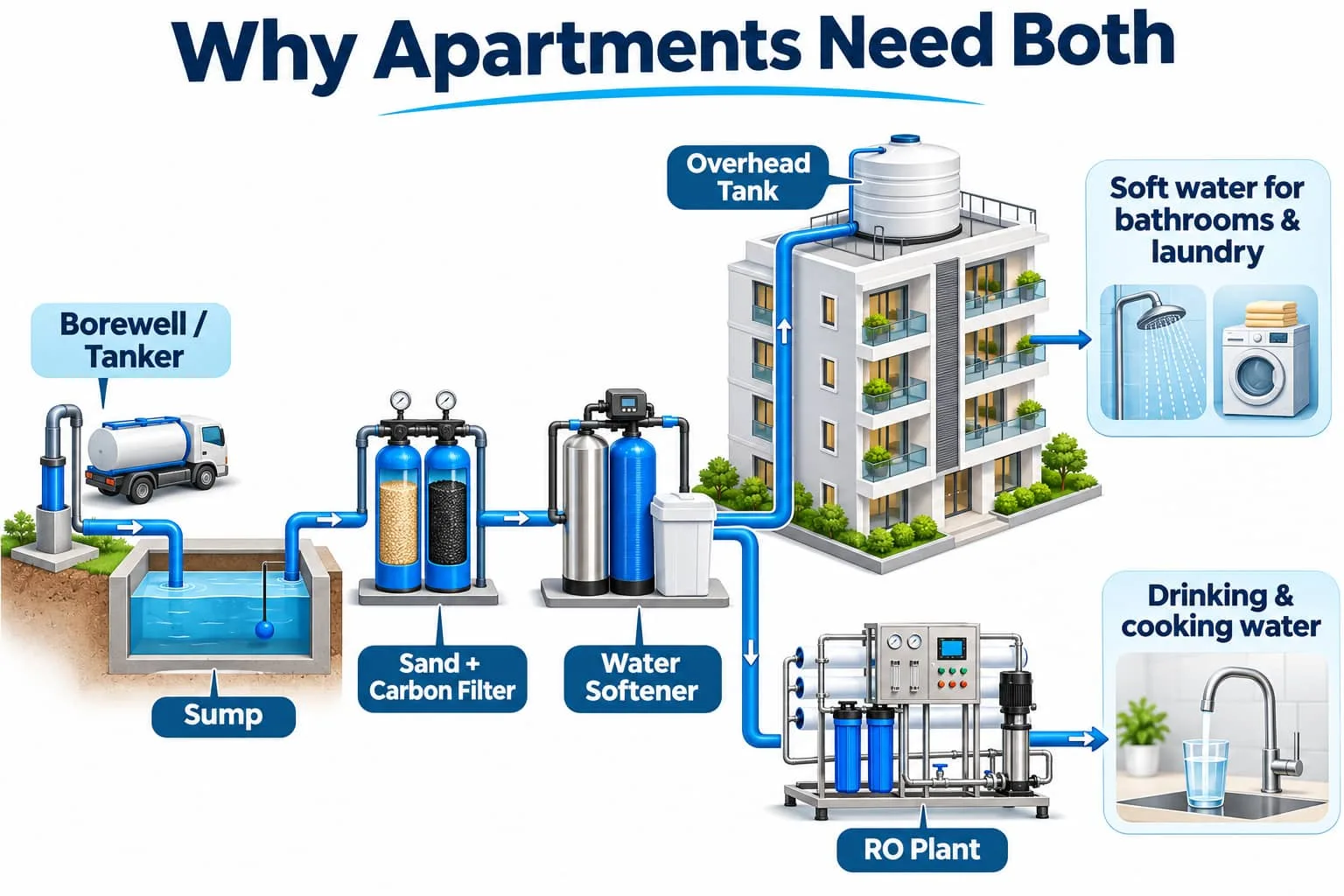
The efficient answer for most apartments with hard, high-TDS water is a two-stage setup:
- Raw water from the borewell, tanker or municipal line is collected in the sump.
- Pre-filtration (pressure sand filter and activated carbon filter, plus iron removal if needed) removes turbidity, iron and odour.
- A central water softener feeds the overhead tank, so every flat gets soft water for bathrooms, kitchens and laundry.
- RO for drinking water, either a central RO plant feeding a dedicated drinking-water line or point-of-use RO units in each flat.
There is a bonus: RO membranes fed with softened water scale far less, so they last longer and need cleaning less often.
Hotels and hospitals follow the same logic at a larger scale. Guest bathrooms, laundry, boilers and kitchen equipment need softened water to avoid scale and stained fittings. Drinking water, ice machines and coffee machines need RO water.
For coastal and borewell-dependent buildings, see our softener in Chennai page, or explore a complete water treatment plant that combines filtration, softening and RO in one system.
FAQs
1. Does a water softener reduce TDS? No. A softener exchanges calcium and magnesium for sodium, so TDS stays about the same. If your TDS is high, you need RO.
2. Is softened water safe to drink? For most people, yes. It contains a little extra sodium, so people on a low-sodium diet should drink RO water instead. In practice, most buildings send softened water to bathrooms and use RO for drinking.
3. If every flat has a domestic RO, do we still need a softener? Yes, if your water is hard. Domestic RO units only treat the kitchen tap. Bathrooms, geysers, washing machines and pipelines still get hard water and still scale. A softener also helps those RO units last longer.
4. Can we use one large RO plant for the whole building instead? It is possible, but usually expensive to run because of power use and reject water. It makes sense only when the TDS is so high that even bathing water needs treatment, and the plant must include a plan for handling the reject.
5. How often does a softener need salt? It depends on your hardness and daily consumption. Automatic softeners regenerate on their own; the brine tank simply needs topping up. A quick weekly check is enough for most buildings.
6. How do I know which one my building needs? Start with a water test that reports TDS and total hardness separately, then match the numbers to the decision table above. If you are unsure, our team can test your water and recommend a softener, an RO plant or a combined system sized to your building.