Sewage Treatment Plant Cost in Tamil Nadu: A Practical Price Guide
If you are planning a sewage treatment plant for an apartment, hospital, hotel, school, IT park or factory in Tamil Nadu, the first question is almost always the same: how much will it cost? The honest answer is that there is no single price. Two STPs with the same capacity can get very different quotes because of the technology used, the site conditions, the quality of treated water you need and, most of all, what is actually included in the scope.
That is why a price list alone rarely helps. This guide explains what really decides sewage treatment plant cost, what you will spend every month after installation, the hidden costs buyers often miss, and how to compare quotes properly so you invest in a plant that keeps working for years, not one that looks cheap on paper.
1. What Decides STP Cost: KLD, Technology, Civil vs. Packaged
Capacity (KLD)
STP capacity is measured in KLD, or kilolitres per day. It is the single biggest cost driver because it sets the size of the tanks, blowers, pumps and filters. Capacity is worked out from the number of people using the building and their daily water use. For residential buildings, design is commonly based on around 135 litres per person per day as per CPHEEO guidelines, and roughly 80% of the water supplied ends up as sewage.
Sizing it right matters. An undersized plant gets overloaded and fails inspection; an oversized one costs more to build and wastes power every single day. A proper site survey and occupancy study is the first step to an accurate estimate.
Treatment technology
The process you choose affects both the upfront cost and the running cost:
- MBBR (Moving Bed Biofilm Reactor): compact, reliable and popular for apartments and commercial buildings where space is limited.
- SBR (Sequential Batch Reactor): automated batch treatment with good outlet quality; suits medium and large capacities.
- Extended aeration / ASP: simple and proven, but needs more land and tank volume.
- MBR (Membrane Bio Reactor): produces the best quality water for reuse and takes the least space, but has higher equipment and membrane replacement costs.
- FAB (Fluidised Aerobic Bio-reactor): a compact option often used in smaller packaged plants.
Civil STP vs packaged STP
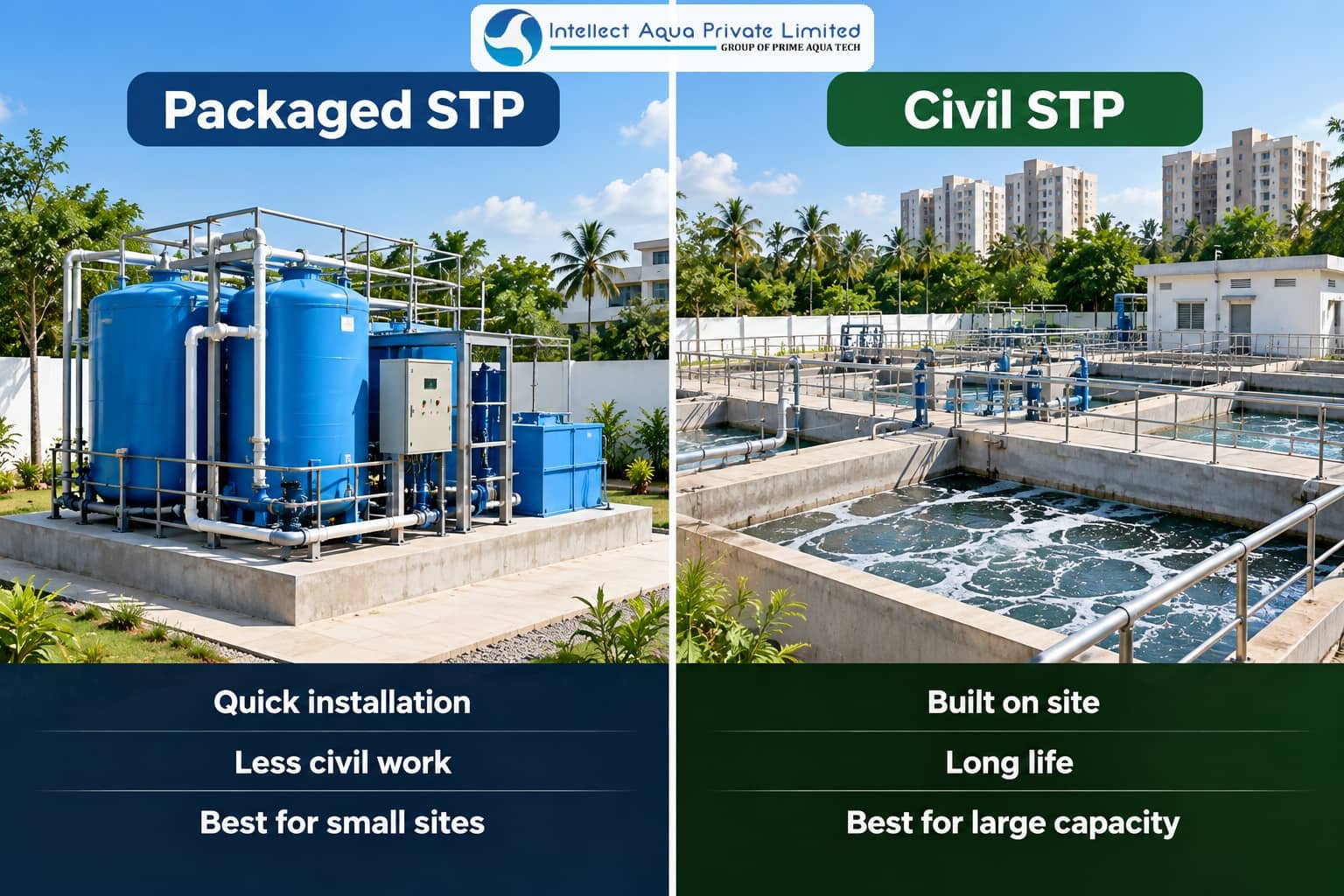
A civil STP uses RCC tanks built on site. It suits larger capacities and long-term installations, but takes longer to build and the civil work is a major part of the cost. A packaged or prefabricated STP comes as ready-made FRP or steel units. It is faster to install, needs less site work and is easier to relocate, which makes it a good fit for smaller capacities, villas, clinics and sites where time is short.
Treated water quality and reuse
If you only need to meet discharge norms, the plant is simpler. If you want to reuse treated water for toilet flushing, gardening or cooling towers, you will need tertiary treatment such as pressure sand filters, activated carbon filters and disinfection by UV or chlorination. This adds to the initial cost but can cut your water bills and tanker dependency considerably.
Apartments and campuses that also want to manage kitchen and food waste can add an organic waste composter next to the STP, or a small biogas plant that turns the same waste into cooking gas.
Site conditions
Available space, soil type, groundwater level, distance from the building and whether the plant is a new build or a retrofit inside an existing basement all change the design and the cost.
2. STP Cost Factors by Capacity Band
Instead of quoting fixed prices that may not match your site, the table below shows what typically drives cost at each capacity level. Use it to understand where your money will go before you request quotes.
| Capacity band | Typical users | Common technology | What drives cost the most |
|---|---|---|---|
| Up to 50 KLD | Small apartments, villas, clinics, schools, offices | Packaged MBBR / FAB | Prefabricated tank, blower and pump quality, compact footprint |
| 50 to 200 KLD | Mid-size apartments, hotels, hospitals, colleges | MBBR / SBR | Civil tanks, blower capacity, tertiary filters for reuse |
| 200 to 500 KLD | Large gated communities, IT parks, malls | SBR / MBBR / MBR | Automation (PLC), standby equipment, sludge handling |
| Above 500 KLD | Townships, industrial estates, large campuses | SBR / MBR / ASP | Custom engineering, heavy civil work, power load, approvals |
The exact figure for your project depends on your KLD, inlet sewage characteristics, outlet norms and site. If you are in the western region, read our guide on STP cost in Coimbatore, or share your requirements with the Intellect Aqua team for a written, itemised quote.
3. Monthly Running Cost: Power, Chemicals, Operator, Sludge
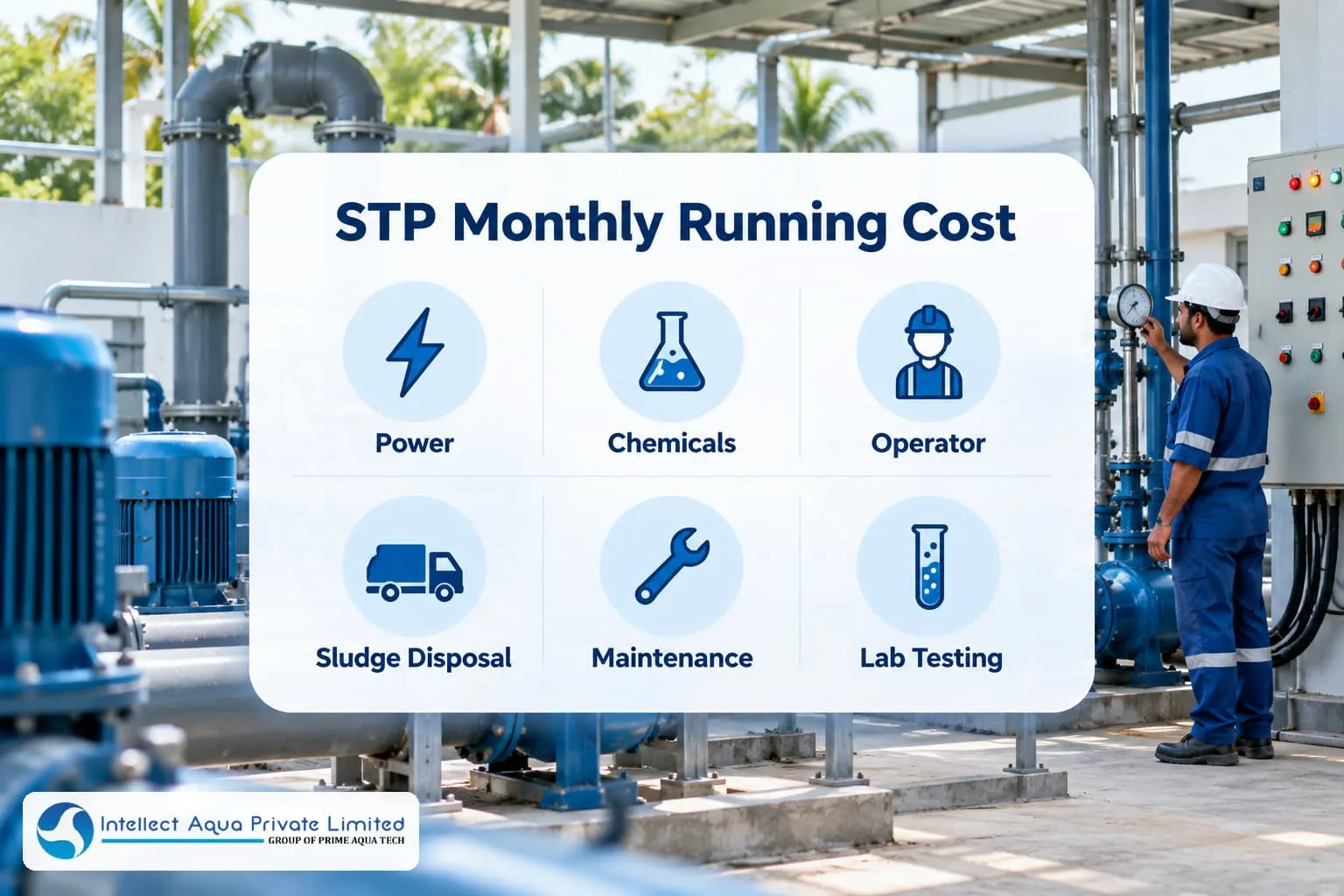
Many buyers focus only on the installation price and are surprised by the running cost later. Over the life of the plant, operating expenses can add up to more than the purchase price, so they deserve equal attention. The main components are:
- Power: air blowers run round the clock and are usually the largest monthly expense, followed by transfer and filter feed pumps. Energy-efficient blowers, fine-bubble diffusers and VFD controls lower this significantly.
- Chemicals: chlorine or hypochlorite for disinfection, and coagulants or polyelectrolyte where needed for clarification and sludge dewatering.
- Operator: a trained operator to run the plant, keep logs and handle daily checks. Larger plants may need operators in shifts.
- Sludge disposal: excess sludge must be removed, dried or dewatered and disposed of properly at regular intervals.
- Maintenance and spares: diffuser membranes, pump seals, blower belts, filter media and UV lamps all need periodic replacement.
- Lab testing: regular testing of treated water for BOD, COD, TSS and other parameters to stay compliant with TNPCB consent conditions.
When comparing plants, always ask each vendor for the expected power consumption in kW and the list of consumables. A plant that is slightly cheaper to buy but draws more power will cost you more within a few years.
4. Hidden Costs Buyers Miss in Quotes
A low quote is often low because something has been left out. Check whether these items are included before you compare totals:
- Civil work: tanks, foundations and equipment rooms are sometimes excluded from "equipment only" quotes.
- Electrical work: the control panel may be included, but cabling from your main panel to the STP often is not.
- Tertiary treatment: filters and disinfection for reuse may be listed as optional extras.
- Standby equipment: a standby blower and standby pumps are essential for uninterrupted operation.
- Sludge handling: sludge drying beds, a filter press or a screw press.
- Odour control and tank covers: important for plants near living or working areas.
- Transport, unloading and installation: including crane charges for packaged units.
- Commissioning: bacterial seeding, trial runs, stabilisation and operator training.
- Approval support: drawings and technical documents needed for TNPCB consent applications.
- AMC after warranty: annual maintenance contract charges once the warranty period ends.
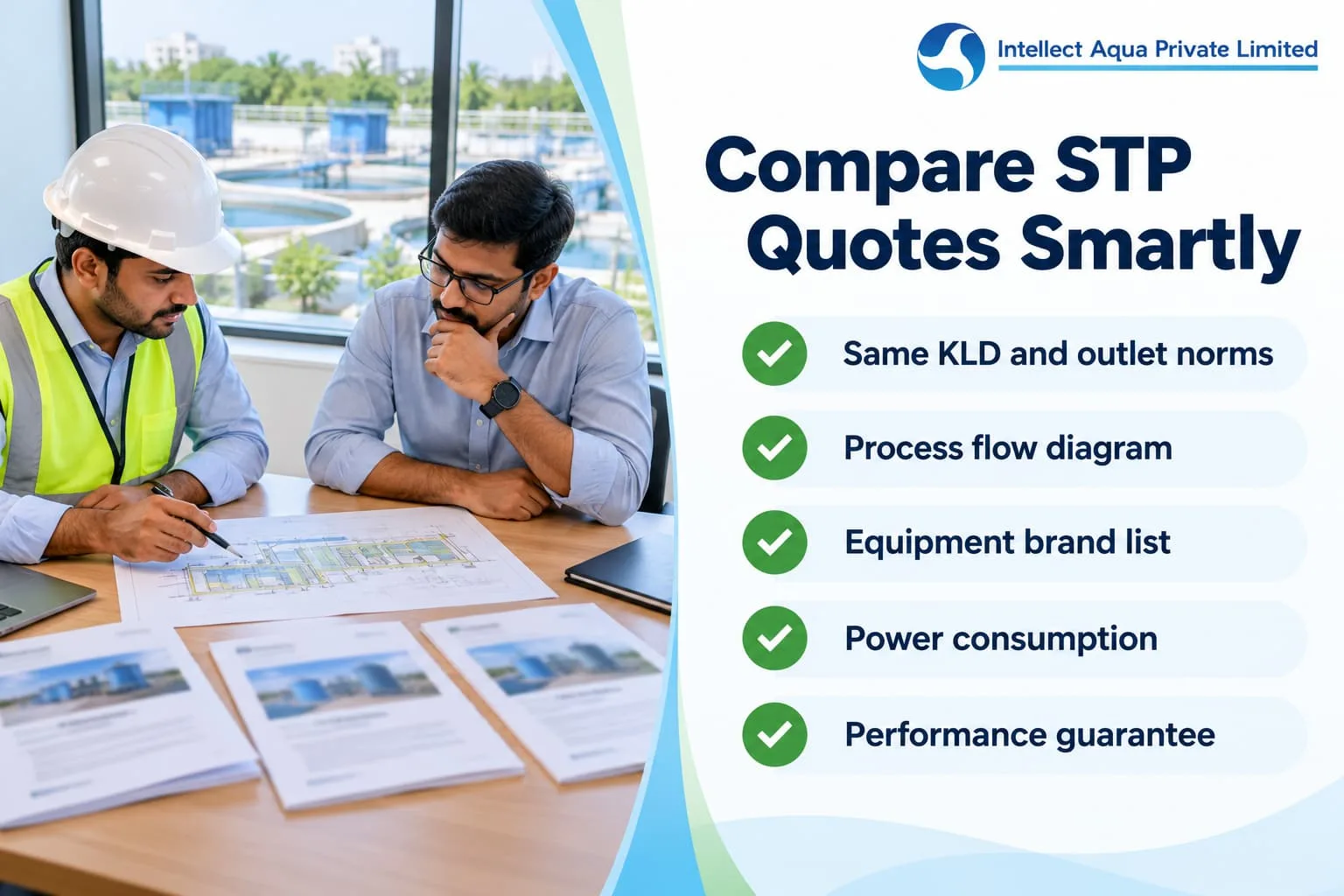
5. How to Compare Three STP Quotes
Getting three quotes is good practice, but only if you compare them on the same basis. Follow these steps:
- Check the design basis. All three quotes should be designed for the same KLD, the same inlet BOD and COD, and the same outlet standards. If one vendor has assumed weaker sewage, their plant will be smaller and cheaper, and may fail later.
- Ask for the process flow diagram. It shows every treatment stage. Missing stages explain many price differences.
- Compare the equipment make list. Blowers, pumps, diffusers, media and panels from reputed brands last longer and have spares available locally.
- Use a scope of supply matrix. List every item, including the hidden costs above, and mark what each vendor includes and excludes.
- Compare power consumption and footprint. Lower connected load means lower monthly bills; smaller footprint frees up space on your site.
- Look for a performance guarantee. The vendor should guarantee outlet parameters in writing, not just supply equipment.
- Review warranty, AMC and O&M terms. Understand response time for breakdowns and what is covered.
- Visit a running plant. A working installation of similar capacity tells you more than any brochure.
A good vendor will walk you through each of these points openly. Whether you are building a sewage treatment plant in Coimbatore, planning an STP in Chennai or anywhere else in the state, Intellect Aqua provides design, supply, installation and maintenance for water treatment across Tamil Nadu.
FAQs
How much does a sewage treatment plant cost in Tamil Nadu?
STP cost depends on capacity in KLD, treatment technology, civil or packaged construction, treated water quality and site conditions. Because these vary for every project, the most reliable figure comes from a site visit and an itemised quote based on your actual requirements.
How do I calculate the KLD my building needs?
Multiply the number of occupants by their daily water use, then take roughly 80% of that as sewage. Add a margin for future occupancy. An STP consultant can confirm this during a site survey.
Which STP technology is the most cost-effective?
There is no single best option. MBBR is cost-effective for compact sites, SBR works well for medium to large plants, and MBR is worth it when you need high-quality water for reuse. The right choice balances upfront cost, running cost and space.
Is a packaged STP cheaper than a civil STP?
For small capacities, packaged STPs are usually quicker and more economical because they need minimal civil work. For large capacities, civil STPs often become more practical over the long term.
What is included in the monthly running cost of an STP?
Electricity for blowers and pumps, chemicals, operator salary, sludge disposal, spares and periodic lab testing. Power is typically the largest component.
Can treated water from an STP be reused?
Yes. With tertiary treatment, treated water can be reused for toilet flushing, gardening, landscaping and cooling, which reduces fresh water purchase and tanker costs.
Does my building need an STP?
Many apartments, commercial complexes, hospitals, hotels, educational institutions and industries in Tamil Nadu are required to install an STP and obtain consent from the Tamil Nadu Pollution Control Board, depending on their size and use. Check the requirement for your project at the planning stage.
Get an Accurate STP Estimate for Your Project
The right sewage treatment plant is not the cheapest one on paper; it is the one that is sized correctly, meets discharge norms every day and costs less to run over its lifetime. Share your building type, occupancy and site details with Intellect Aqua, and our team will recommend the right technology and provide a clear, itemised quote with no hidden exclusions.