Desalination Plant Explained: How Seawater Becomes Drinking Water
A desalination plant removes dissolved salts from seawater or brackish water and produces water that is safe for drinking, industrial use or irrigation. For coastal industries, resorts and areas with saline borewell water, it is often the only dependable source of fresh water.
This guide explains how a desalination plant works, its main stages, where it is used and what to check before installing one.
What Is a Desalination Plant?
A desalination plant is a water treatment system that separates salt and other dissolved solids from saline water. The most common method today is reverse osmosis (RO). Seawater is pushed at high pressure through semi-permeable membranes that let water pass and hold back the salts.
Water sources are usually grouped as:
- Seawater: around 35,000 mg/L of dissolved salts (TDS).
- Brackish water: roughly 1,000 to 10,000 mg/L TDS, common in coastal borewells and some inland aquifers.
Seawater needs higher pressure and more energy than brackish water. That is why the two are designed and priced differently.
How Does a Desalination Plant Work?
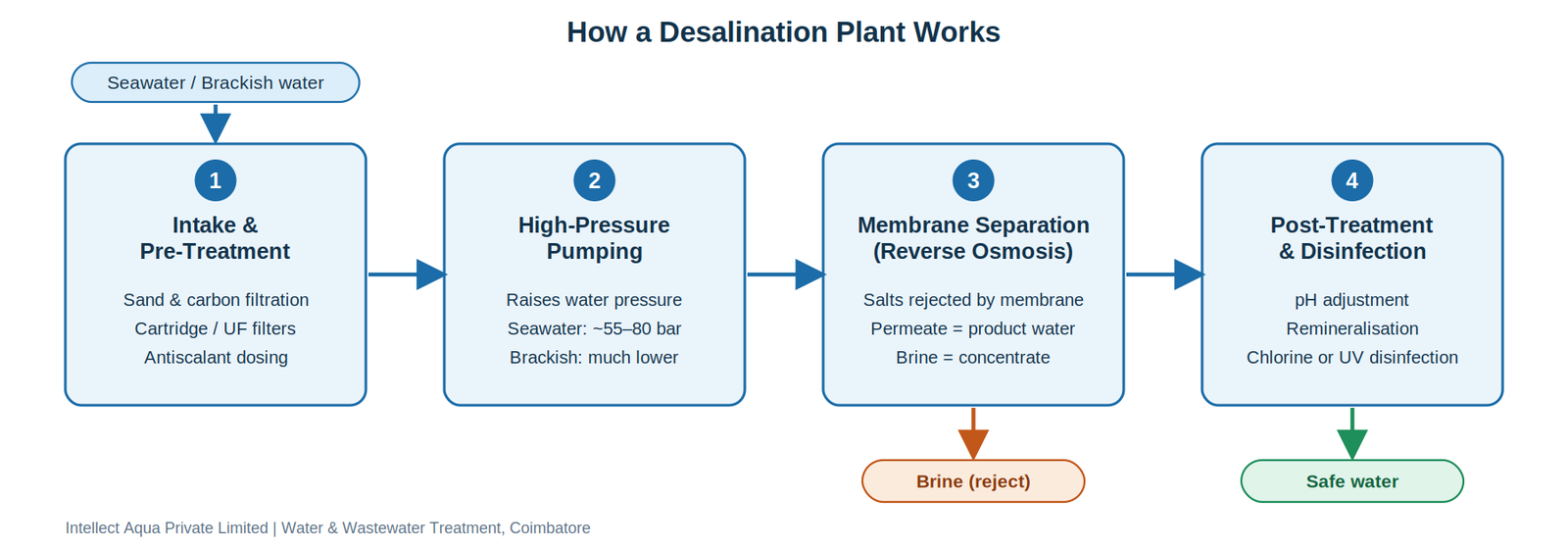
Most plants follow four stages.
1. Intake and Pre-Treatment
Raw water is drawn from the sea, a beach well or a borewell. It contains sand, silt, algae and organic matter that can foul the membranes, so pre-treatment is critical. Typical steps are:
- Coagulation and settling
- Pressure sand filter for turbidity and suspended solids
- Activated carbon filter to remove chlorine and organics
- Cartridge filters, or ultra filtration for tighter protection
- Antiscalant dosing to prevent scale on the membranes
Poor pre-treatment is the most common reason desalination membranes fail early.
2. High-Pressure Pumping
A high-pressure pump raises the water pressure well above its natural osmotic pressure. Seawater systems typically run at about 55 to 80 bar, while brackish systems need much less.
3. Membrane Separation (Reverse Osmosis)
Inside the membrane vessels, pure water passes through while salts and impurities are rejected. This produces two streams:
- Permeate: the low-salinity product water
- Brine (reject): the concentrated salty stream sent for disposal
Seawater plants usually recover around 40 to 50 percent of the feed as product water. Brackish plants can recover more.
4. Post-Treatment
RO water is very pure and slightly acidic, so it is conditioned before use:
- pH adjustment
- Remineralisation if it is for drinking
- Disinfection with chlorine or UV
Seawater vs Brackish Water Desalination
| Factor | Seawater | Brackish Water |
|---|---|---|
| Feed TDS | About 35,000 mg/L | 1,000 to 10,000 mg/L |
| Operating pressure | High | Low to medium |
| Energy use | Higher | Lower |
| Recovery | Lower | Higher |
| Typical use | Coastal industry, resorts | Borewell water, inland industry |
If your water source is a coastal borewell, brackish water desalination is usually far more economical than a full seawater plant.
Where Are Desalination Plants Used?
- Coastal industries such as textile, chemical and power
- Hotels and resorts near the sea
- Residential projects with saline borewell water
- Boiler feed and process water
- Islands and remote locations without a freshwater supply
What Affects the Cost?
Cost depends on several things, not just plant capacity:
- Source water quality: TDS, turbidity, organics, temperature
- Capacity: the daily water requirement
- Pre-treatment needs: worse raw water means a bigger pre-treatment train
- Energy consumption: the largest running cost in seawater plants
- Brine disposal: discharge rules and the method used
- Automation and monitoring: manual or PLC based
A proper water analysis before design saves money, because it avoids both undersized and over-engineered plants.
Common Mistakes to Avoid
- Skipping a full water test before design
- Cutting corners on pre-treatment
- Ignoring brine disposal rules
- Not planning membrane cleaning and replacement
- Choosing a plant without an annual maintenance contract
Why Choose Intellect Aqua?
Intellect Aqua is a Coimbatore-based water and wastewater treatment company with 15+ years of experience and 700+ projects. We design, manufacture, install and maintain plants with ongoing support through annual maintenance contracts.
Need a desalination plant for your industry, resort or project? Share your water source and daily requirement, and our team will suggest the right design.
Frequently Asked Questions
1. What is the difference between desalination and RO?
Desalination is the goal of removing salt from water. Reverse osmosis is the most common technology used to do it. See our RO plant page for more.
2. Can borewell water be desalinated?
Yes. Saline or brackish borewell water is commonly treated with brackish water RO systems.
3. How much does a desalination plant cost?
It depends on capacity, source water quality and pre-treatment. A water analysis is needed before an accurate quote.
4. What happens to the brine?
Brine is disposed of as per local pollution control norms, through approved discharge methods, or reduced further with ZLD systems where required.
5. How long do desalination membranes last?
With good pre-treatment and regular cleaning, membranes typically last several years. Actual life depends on feed water and operation.